Under-curing and over-curing are something all powder coaters want to avoid but some may not realize this is happening. Often times powder coating involves substrates that vary in thickness.
Powder coat curing does not begin until the substrate reaches the specified cure temperature. So what does this mean when trying to cure powder over a part ranging from 5/8" thick cast-iron to 3/16" thick steel plate all within a single piece?
Many powders of today have what is known as "Overbake Protection". Here is a brief description of what that is...Overbake is the result of curing powder coat at too high of a combination of time and/or temperature. The film often becomes too hard and may embrittle also causing the gloss level or color to be adversely affected. Many powders have Overbake Protection built-in allowing a powder to cure double the allotted cure time. This is especially important for curing substrates with varying thickness. Overbake protection does not apply for too high of temperature.
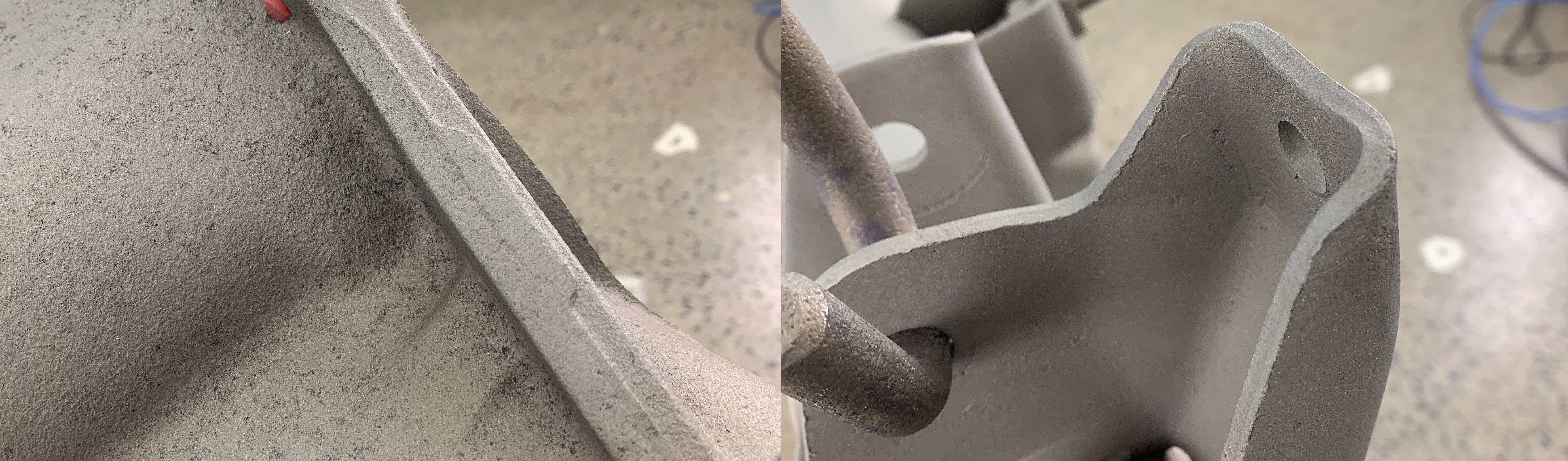
Substrate prior to Zinc-Rich Primer ESS-10171 application followed by Card Black PSS-1523
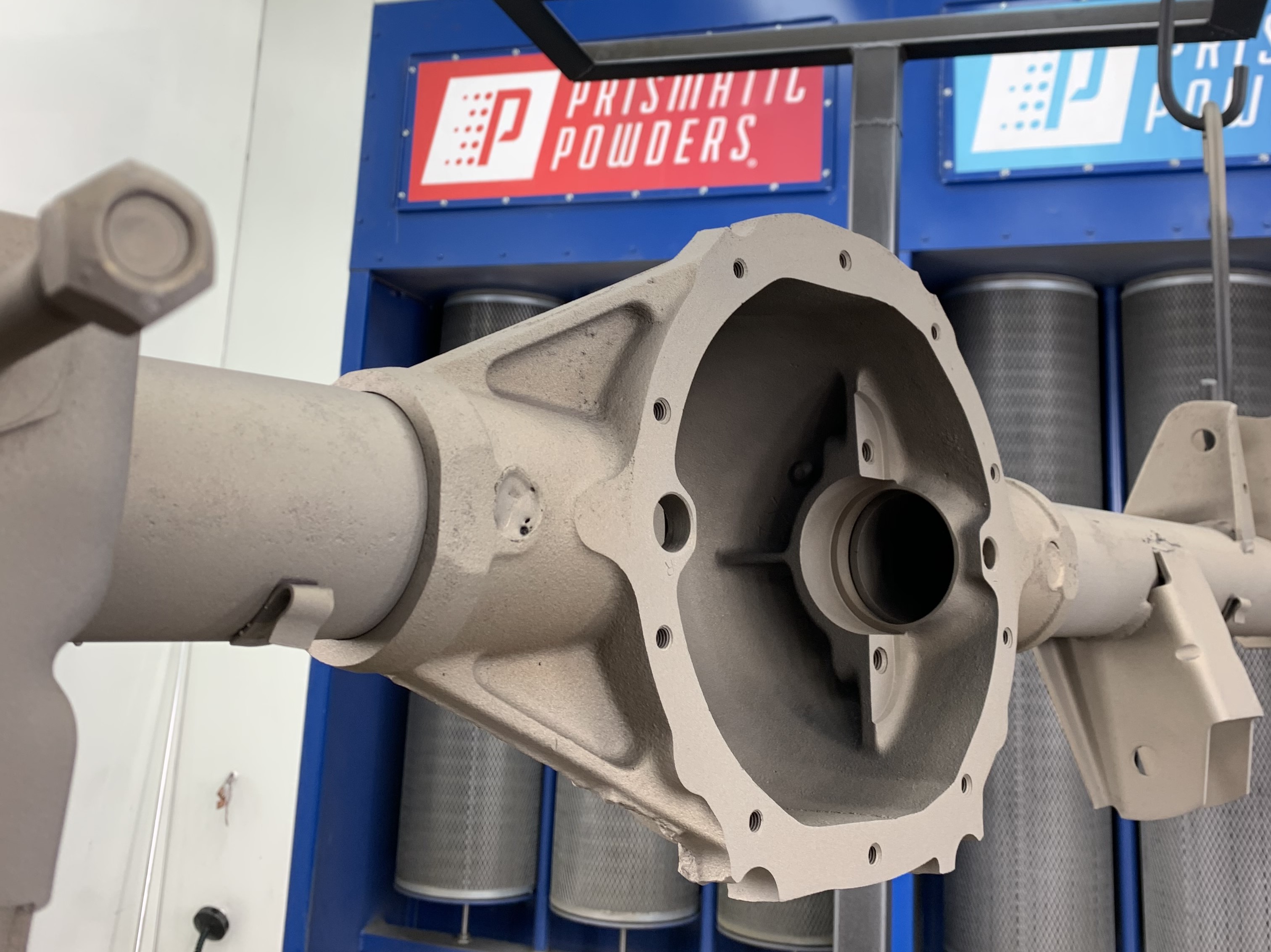
Throughout the application process including "flow-out" of the Zinc-Rich Primer ESS-10171 and full curing of Card Black PSS-1523 an infrared thermometer was used to watch various areas of the substrate for temperature. The areas pictured were the main areas of focus. The heavy cast center was the thickest portion of this piece and the control-arm bracket was the thinnest area with everything else falling between these two thicknesses.
When applying the Zinc-Rich Primer (not pictured), the control-arm bracket could reach "flow-out" and eventually fully cure before the cast-iron center section has even reached flow-out temperature, so it's important to monitor temperature progress. Flow-out is a process that happens around 250 degrees F. where the powder turns from a powder-state into what looks like a liquid-state. The center section took slightly longer to reach flow-out stage and while waiting for this heavy center section to reach "flow-out" the concern is the control-arm bracket going too far beyond the "flow-out" stage and starting to cure or cross-link. A "flowed-out" base coat under a fully cured top coat will provide the best long-term durability and adhesion. If a base-coat (Zinc-rich primer ESS-10171) is fully cured before placing the top-coat (Card Black PSS-1523) long-term durability can be compromised.
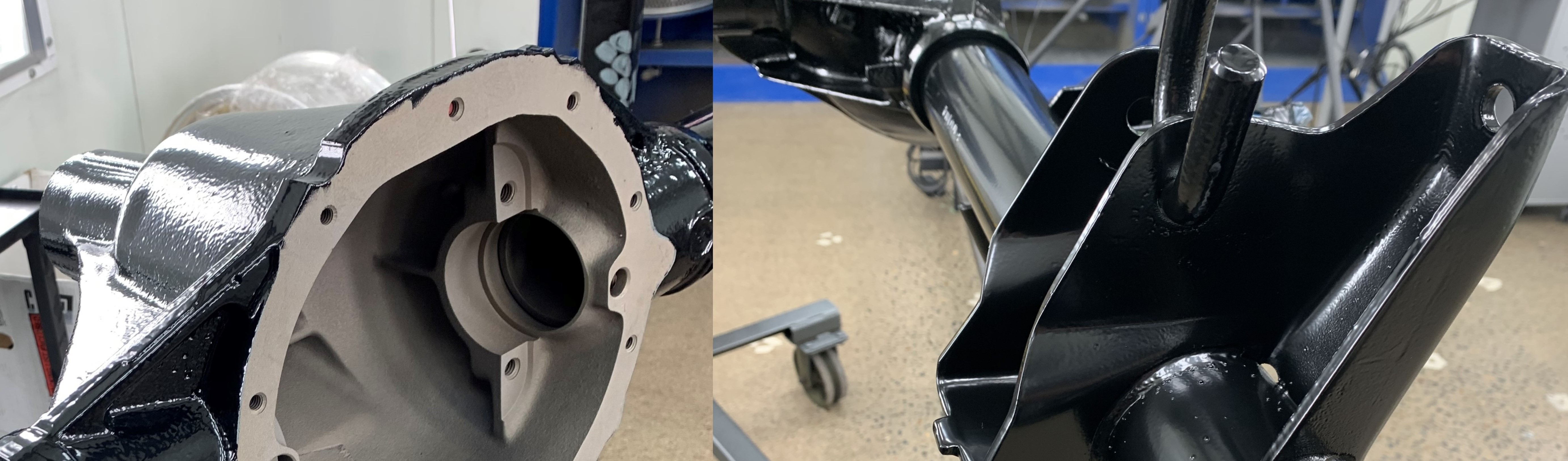
Differential housing after Zinc-Rich Primer ESS-10171 and Card Black PSS-1523
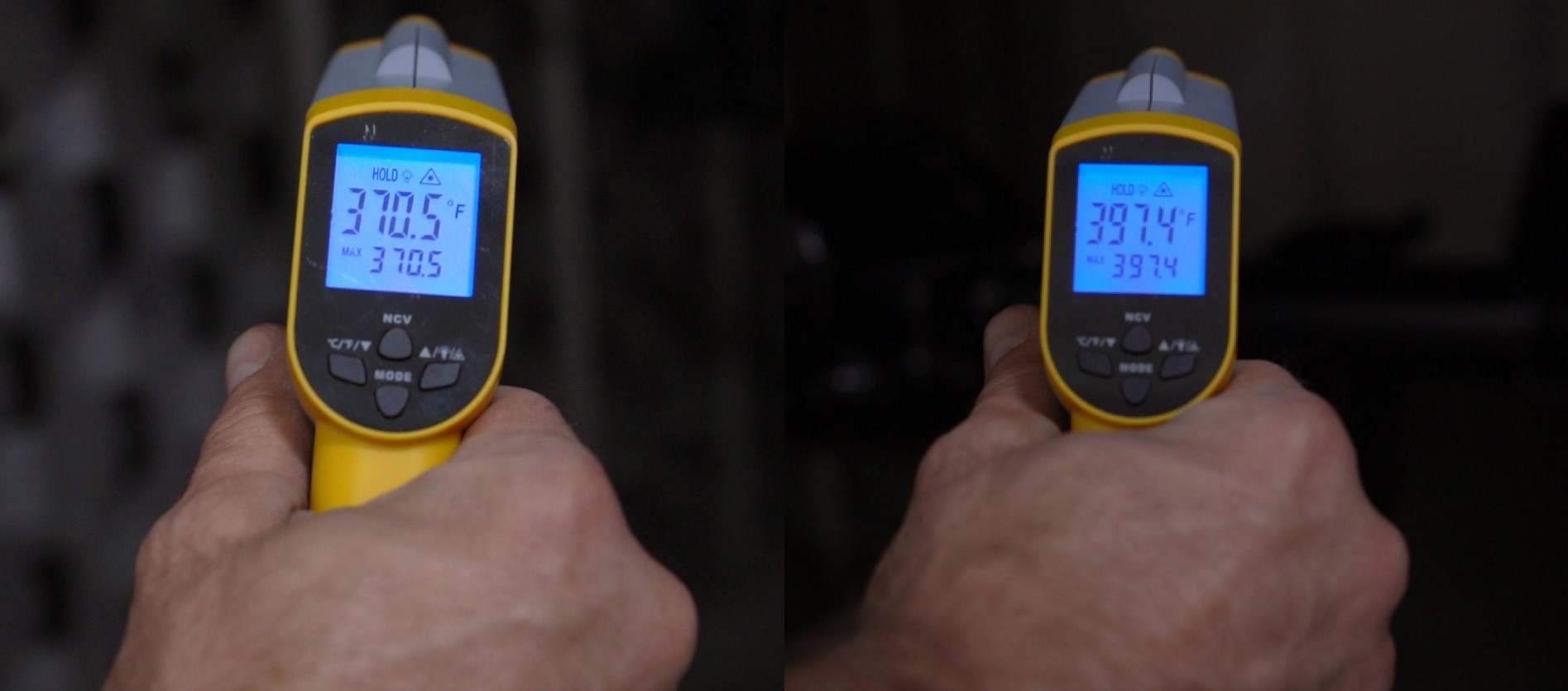
The images above represent the thickest and the thinnest portions of this Differential Housing. Below are temperatures taken of both areas while waiting for the thickest portion of the substrate to reach curing temperature. Remember, the thickest portion MUST reach the cure temperature of 400 degrees F. (Card Black Cure Temperature) before setting the cure timer. As seen in the image below The Control Arm bracket (right I.R. gun picture) has pretty much reached cure temperature, while the center cast portion of the differential is still climbing (left I.R. gun picture).