Simply applying a "one size fits all" method with regard to partial curing can lead to issues of delamination and inconsistent looking finishes.
As always, whenever you're tackling territory that is unfamiliar to you, spray out a sample first. It's better to discover issues on samples rather than production pieces.
There can be a bit of confusion with regard to a partial cure. That is to say, how do you know when a partial cure has been achieved? Internet forums are full of opinions about what is correct; and the truth is many are correct, but of course, there is also some bad advice that can get you into trouble.
SO, LET'S TRY AND CLEAR A FEW THINGS UP.
A partial cure can be anywhere between the time that the powder flows, or 'gels' up, to just before a full cure. Is a 50% cure or 75% cure a partial cure? Yes, but so is a powder that has only just reached flow out. Varying chemistries within different powder types means that there is no single method that works best for every powder type.
WHY OR WHEN IS A PARTIAL CURE IMPORTANT?
A partial cure is important when a second coat such as a top coat is to be applied to a base coat. A partially cured powder will allow the two contacting coats to bond together both mechanically and chemically. This helps to ensure the strongest possible finish is achieved.
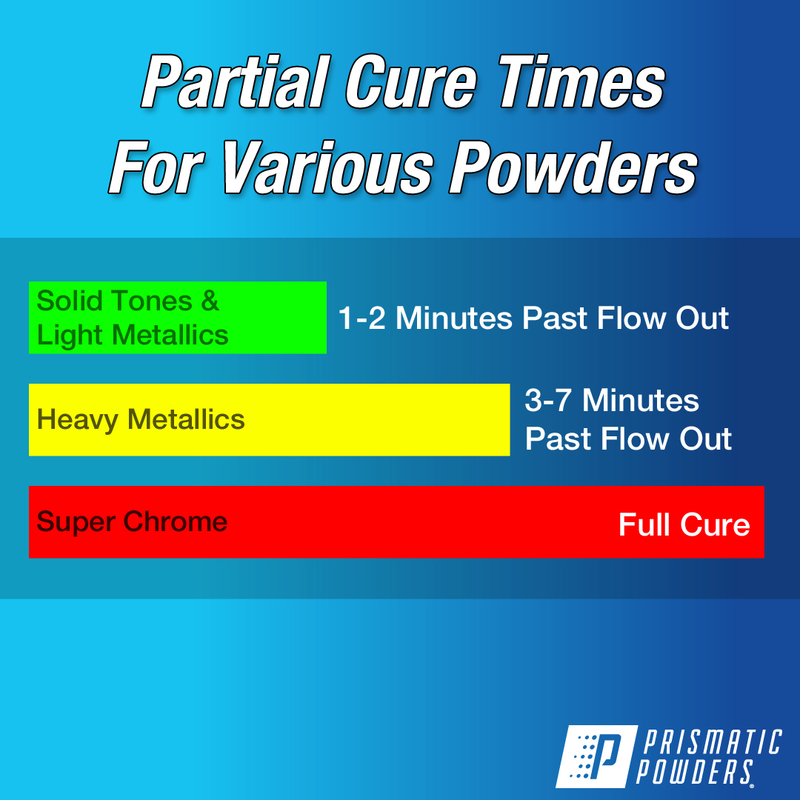
General rule for Prismatic Solid Tone Colors: for solid tone and many powders with light metallic particles, removing them from the oven just a couple of minutes after complete flow out is fine. Keep in mind, you do not have to monitor part metal temp (PMT) for a partial cure, you only need to monitor the state or condition of the powder as it flows. You do not have to apply the second or top coat hot for proper bonding, in fact we discourage the use of the "hot flocking" technique whenever possible. As the base coat reheats, it re-gels and bonds with the top coat is it melts. The two coats will cure together when the cure schedule for the top coat or second followed correctly.
General rule for Prismatic Metallic Colors: the correct partial cure state is a little trickier for powders that have heavy metallic content, for which a different method should be used. Metallic particles tend to move underneath a top coat if they have just reached a gel state, thus it is important to allow a few minutes of extra baking time after the powder flows to allow the metallic particles to stabilize. How many extra minutes depends on the thickness of the metal and how quickly your oven heats. Slower heating ovens and thicker substrates may require extra time. Additionally, metallic particles can move and shift inconsistently when top coated hot; which is another reason why we do not recommend "hot flocking".